In the immortal words of my first ex-wife “I need my space.”
Like many Americans, especially of my age bracket we have been amazed by the space program. I was almost 2 years old when Neil Armstrong took those first steps on the moon. I grew up with Boy’s Life magazine speculating we would have a permanent human presence on the moon by 2001. I remember doing the math figuring I would be in my 30s when the moon base would be a certainty. I played sick the day the 1st shuttle mission returned to earth when there were concerns about the thermal tiles being in place for re-entry.
And while my career path has not been one that involved S.T.E.M. (Science Technology Engineering Math) I have always been a fan of science and the space program in particular. The amazement I have had for launching mankind away from the surface of earth has never been satiated, but the Kennedy Space Visitors Complex (KSVC) has come close.
The KSVC was founded in 1963 by the N.A.S.A. Administrator Jame Webb (yes, the telescope was named after him) which was just a simple trailer along with a self-guided self-driven tour of part of Cape Canaveral Air Force Station. I went with my family in the late 1970s, and I don’t remember much except how big the Saturn rocket was, and it was laying on its side outside, the bus tour that took us up to the Vehicle Assembly Building and how we got to drive up to the launch pad. 
The bus tour still takes place, and you get to drive past the huge Vehicle Assembly Building but nowadays you don’t get within a mile of the launch pads. Kennedy Space Center is now a bustling, busy, active, high tempo operational facility. While I was there were three launches that were scheduled to take place within 48 hours. When I went there in the summer of 1977, it had been three years since the last Skylab mission and the Space Shuttle Columbia was not going to have its inaugural flight until 1981.
 To say that the KSVC has changed since my visit during the space doldrums of the late 70s to the present would be an understatement. What used to be couple of hours to take it all in has now progressed to a full two-day excursion (depending on how much you read and interact with the exhibits). Sure, a person could simply walk through the exhibits, oohing and awing, not really ingesting knowledge, simply being amazed by the size and scope of the exhibits but you would be missing so much.
Before I go on with my recommendations for how to tour this amazing place please be aware that I don’t travel with children so some of the knowledge could go right over their heads. I was about ten or so when I first went and while I do not remember details, I do remember the wonder I took away from the place. I would think most things would not be suitable or enjoyable for anyone under the age of 7 or 8 depending on how much they like learning and space in particular. Also, there are ratings for autism and sensory sensitive people along with it being fully ADA compliant.
The KSVC does not take cash, all transaction must be done with a credit or debit card. Like most tourist places there is a hidden fee, you have to pay for parking. Even though it’s the middle of swamp and there are no possibly of thefts from any one or anything nearby (although wildlife is always a concern, a couple of years ago an alligator got into the Vehicle Assembly Building by using an automatic door) and there is no tram to take you to the gate like Walt Disney World, nor anyone directing you where to park.
There are several places to eat and grab snacks, but again no place takes cash only cards, although there is a cash-to-card service. I did not use this so I cannot comment on the ease of it. I had fountain drink, fries, and chicken tenders at the Moon Rock Café at the Apollo/Saturn V Center, it ran me $15.00 so pretty standard tourist prices and average food. Again, arriving early I stayed ahead of the crowds so I walked through the line using the automated kiosk, but while I was eating the line got rather long.
The presentations are all top notch. I work in one of the premier entertainment locations in the world. The KSVC easily competes with my employer. I would not be surprised if some Disney Imagineers were consulted for the planning of presentations. From the reenactment of the countdown of Saturn 11, to the feeling the rumble of a launch of the space shuttles, to the queue areas before each show, it is all top notch and engaging to the fullest. And not to disparage my place of employment, but the Kennedy Space Center has a real-world very active mission and its impact will be felt forever in human history.
This is my recommendation for seeing the KSVC, for either one day or two days depending on your desire for knowledge and how much time you have to spend.
One Day Tour:
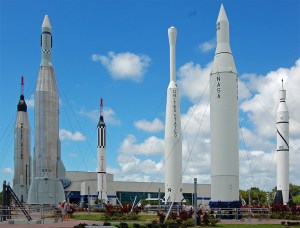
Guided Tour of Rocket Garden (for scale and history) About 20 minutes, outside. So, the earlier the better.
Kennedy Space Center Bus which takes you to The Apollo/Saturn Center Bus Tour (beat the tour groups, get on it first thing, I stayed just ahead of the crowds and tour groups most of the day.)
Space Shuttle Atlantis (I did not ride the simulator, but if you chicken out like me, you can watch your friends experience it, which is kind of fun.)
Imax – Every 2 hours on the hour, 2 films but I suggest the Space the New Frontier
The U.S. Astronauts Hall of Fame and the Space Mirror Memorial.
Two Day Tour:
Day One: Again, I suggest you start the Rocket Garden Guided tour.
Then The Apollo/Saturn V Center via the Bus Tour (I was out by 3 pm, with time to take a dip in the ocean.)
Day Two: Space Shuttle Atlantis (I did not ride the simulator, but if you chicken out like me, you can watch your friends experience it, which is kind of fun.)
Imax – 2 films to choose from one every hour on the hour, I suggest the Space: The New Frontier, narrated by Chris Pine
Journey to Mars
Gateway (this has a ride similar to Flight of Passage at Disney’s Animal Kingdom but with four different choices).
The U.S. Astronauts Hall of Fame, it is to the right as you exit.
There are additional add-ons, The Astronaut Training Stages, the Chat With An Astronaut and the longer Kennedy Explore Space Tour (bus tour, with additional stops then the Kennedy Space Center Bus which is included with the admission price.)
A couple of things I suggest to not miss: At both The Apollo/Saturn V Center and the Space Shuttle Atlantis there are moving tributes to the astronauts lost during those programs. A solemn reminder that these are risky, dangerous endeavors. Another not to miss is the interactive holographic presentations by Apollo astronauts who tell their stories and answer pre-programmed questions. Both the Apollo and Atlantis locations have a wider variety of merchandise in their gift shops for those specific programs then the main gift shop, The Space Shop.
Like I stated earlier I love N.A.S.A. and the space program. I remember the summer of 1979 when Skylab came down. I was at Boy Scout Camp and there were  fluorescent orange painted nuts and bolts scattered around the camp, if you turned them in at the snack bar, you got an ice cream cone. Skylab actually came down that very week, not in Pennsylvania but deep in the Australian outback with no injuries or property damage.
Space exploration is a chance to dream about what’s over the next hill, of going to see what is beyond the horizon. I am fascinated with exploration of Moon, Mars, the asteroid belt and whatever we can reach after that. And when we do reach Mars and beyond, we will be doing it from a unique perspective, from the top down. In the past we actually had to travel to find what was in an unknown place, we had to sail along a coastline to map it, we had to walk over a mountain to see what was on the other side. But when we reach Mars with crewed flights, we will approach it from above, no real mystery where to land, or what’s just over the hill from our landing site. Instead, we will be looking for water and minerals to sustain long-term settlement.
Many of us may not all understand orbital mechanics, the lift power of solid fuel versus liquid fuel, or how to calculate G forces on the human body. S.T.E.M. takes a lot of brain power that not everyone is inclined towards or gifted with. But we can appreciate the bravery, intelligence, amazing cooperation, and drive of the space program.
Humanity needs a horizon to reach for, we need to continually increase our knowledge of the universe around us, it is necessary to continuously flex our curiosity muscles. Exercise keeps a human being healthy; exploration is food for a healthy human soul. We all need dreams, hope, we need to look for new possibilities.
We need space.
Categories: Travel and Diversions
 Stories and Quotes from the Mind* and Keyboard of A.A.Forringer
Witty observation, disparaging remark, question for A.A., well this is your chance.